

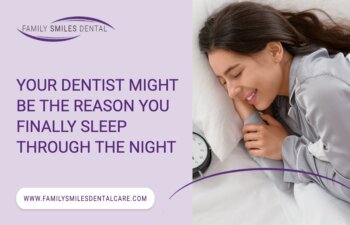
Patients come to us for cleanings, crowns, and the occasional emergency. Sleep is not usually on the agenda. But a dental exam happens to include a direct look at the airway, the tongue, the soft palate, and the wear patterns on the teeth — which together often reveal a sleep problem that nobody has connected to anything.
The classic version of this conversation starts with a patient mentioning, almost as an aside, that they are tired all the time. Or their spouse has moved to another room because of the snoring. Or they have been told they grind their teeth and have no idea why.
At Family Smiles Dental in Dallas, Dr. Hope Still, DDS, and Dr. Leslie Sclafini Patrick, DDS, provide sleep apnea treatment as part of the practice — and recognizing who should be evaluated is often where it starts.
What Is Happening During Sleep
Obstructive sleep apnea occurs when the soft tissues of the throat relax during sleep and narrow or block the airway. Breathing stops or becomes severely restricted, oxygen levels drop, and the body responds by partially waking to reopen the airway.
Then it happens again. In significant cases this cycle repeats many times per hour, all night, every night.
The person experiencing it usually has no memory of any of it. They are not aware of waking, because the arousals are brief and incomplete. What they experience is the downstream effect: sleeping eight hours and feeling as though they slept four.
Why It Matters Beyond Fatigue
This is a medical condition rather than an inconvenience, and the reason for taking it seriously is what repeated oxygen desaturation does over years.
Untreated obstructive sleep apnea is associated with high blood pressure, cardiovascular disease, stroke, type 2 diabetes, and daytime impairment serious enough to affect driving safety. The associations are well established in the medical literature, which is why this is not a condition to manage casually.
It is also, importantly, a diagnosis that belongs to a physician. Dentistry has a specific and valuable role in treatment, but the diagnosis comes from a sleep study interpreted by a medical provider. Any dental office that offers to diagnose sleep apnea is overstepping.
The Signs We Notice in a Dental Exam
Several findings in the mouth correlate with airway problems, and they are visible to us whether or not the patient has mentioned sleep.
- Worn or Flattened Teeth: Grinding and clenching are strongly associated with disrupted breathing during sleep. In many patients, the clenching is part of the body’s effort to reopen a narrowed airway.
- Scalloped Edges on the Tongue: Indentations along the sides of the tongue from pressing against the teeth, a finding often seen in patients with airway issues.
- A Crowded Airway on Examination: Large tonsils, a long soft palate, or a tongue that fills the oral cavity all narrow the space available for air.
- Chronic Dry Mouth: Mouth breathing during sleep, which both indicates and worsens airway problems.
- Morning Headaches and Jaw Soreness: The consequence of overnight clenching, and one of the most common complaints that turns out to be airway-related.
- A Narrow Upper Jaw or High Palate: Structural features that reduce airway volume.
None of these prove sleep apnea. All of them are reasons to ask the next question.
Where the Oral Appliance Fits
For patients with a confirmed diagnosis, treatment options exist along a spectrum, and the dental contribution is the oral appliance.
A custom oral appliance is worn during sleep and works by holding the lower jaw slightly forward, which brings the tongue and soft tissues forward with it and helps maintain an open airway. It is fabricated specifically to the patient’s bite, adjusted over a series of appointments to find the effective position, and is roughly the size of an athletic mouthguard.
For whom is it appropriate? Generally patients with mild to moderate obstructive sleep apnea, and patients with more severe disease who have tried CPAP and cannot tolerate it. CPAP remains the most effective treatment for severe apnea, and an honest conversation says so. But a CPAP machine sitting unused in a closet is treating nobody, and an appliance that gets worn every night is better than a therapy that does not.
The practical appeal is straightforward: it is small, it is quiet, it requires no electricity, and it travels easily. Compliance with oral appliances tends to be high for exactly those reasons.
How the Process Works
The sequence matters, and it involves more than one provider.
It starts with recognizing the signs, which often happens at a dental visit. From there, a sleep study is required — either in a lab or, increasingly, with a take-home test. That study is interpreted by a physician, who establishes the diagnosis and its severity.
With a diagnosis in hand, treatment options are discussed. If an oral appliance is appropriate, we take records and have a custom device fabricated. Fitting is followed by a series of adjustment appointments, because the effective jaw position is found incrementally rather than set correctly on the first day.
Follow-up testing confirms whether the appliance is actually working. That step is sometimes skipped and should not be — an appliance that reduces snoring without resolving the apnea gives false reassurance while the underlying oxygen desaturation continues.
What to Expect From Wearing One
Some adjustment is normal. Patients commonly report jaw soreness in the morning during the first weeks, increased salivation or dry mouth, and some awareness of the appliance. These generally settle.
Long-term appliance wear can produce small changes in bite relationships over the years, which is one reason ongoing dental monitoring is part of treatment rather than optional. We watch for it and address it.
If Any of This Sounds Familiar
The patients who benefit most are the ones who have normalized their symptoms. Years of being tired, years of snoring, years of waking with a sore jaw, all filed under getting older or having a busy life.
If someone has told you that you stop breathing at night, that is worth acting on now rather than mentioning at your next cleaning. If you wake up tired despite adequate time in bed, that is worth raising. The evaluation is straightforward, and the pathway from question to answer is shorter than most people assume.
Schedule an Evaluation at Family Smiles Dental
If snoring, daytime fatigue, morning headaches, or unexplained tooth wear sound familiar, we can assess the dental and airway findings and help coordinate the next step with a sleep physician.
Family Smiles Dental serves families throughout Dallas, Paulding County, and the west Atlanta area.
Medically reviewed by Hope Hutchison Still, DDS on
Posted on behalf of
2713 Charles Hardy Pkwy., Bldg. 100, Ste. 112
Dallas, GA 30157 on Google Maps
Phone: (770) 505-4746
Email: [email protected]
We are open 4 days each week, on alternating Mondays and Fridays.
Mon: 9AM - 5PM
TUE: 9AM - 5PM
WED: 9AM - 5PM
THUR: 9AM - 3PM
FRI: 9AM - 5PM